

- B2B MARKETING
- 23 October 2026
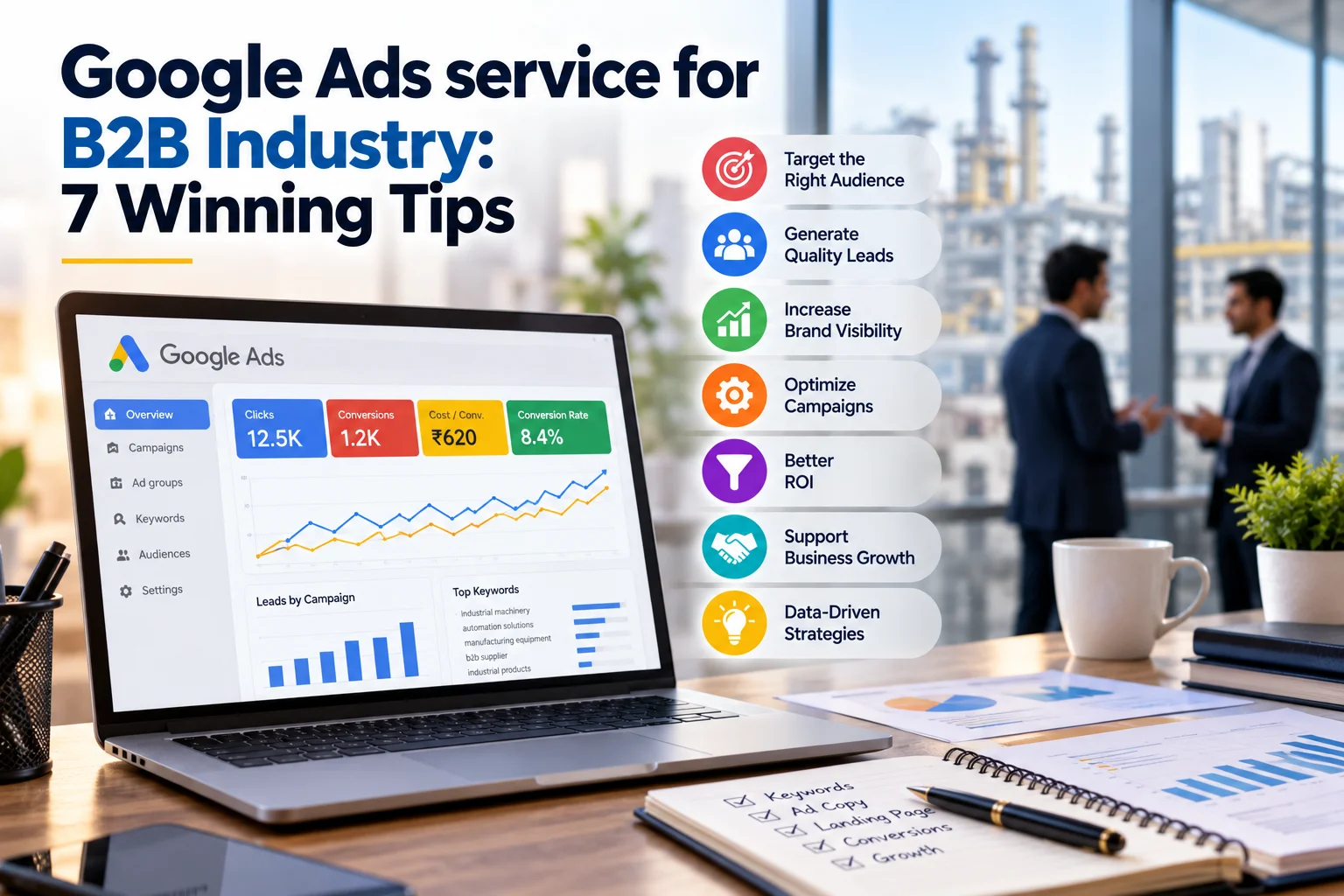
Google Ads Service for B2B Industry: 7 Winning Tips
Generating qualified business leads is one of the biggest challenges for companies operating in the B2B sector. Buyers often compare multiple suppliers, review technical specifications, consult internal teams, and evaluate budgets before making a purchase. A well-planned Google Ads service for B2B Industry can help businesses reach potential customers while they actively search for relevant products, services, and solutions.
Unlike many consumer purchases, B2B buying decisions may involve long sales cycles, multiple decision-makers, and high-value contracts. Therefore, successful advertising requires more than generating clicks. Businesses need to attract relevant prospects, communicate their value clearly, and measure how advertising contributes to enquiries, sales opportunities, and revenue.
Brandbanalo helps businesses explore performance marketing strategies designed around their marketing goals. By combining keyword research, campaign structure, audience targeting, conversion tracking, and continuous optimization, companies can build a more organized approach to paid search advertising.
This guide explains how Google Ads can support B2B growth, which campaign strategies matter most, and how businesses can evaluate an advertising partner for long-term performance.
Table of Contents: What Is Google Ads Service for B2B Industry? | Why B2B Companies Should Invest in Google Ads | Google Ads Service for B2B Industry: 7 Effective Strategies | Choosing the Right Keywords for B2B Advertising | How to Measure Google Ads Campaign Performance | Common B2B Google Ads Mistakes to Avoid | Why Consider Brandbanalo for B2B Google Ads? | Frequently Asked Questions | Conclusion
What Is Google Ads Service for B2B Industry?
Google Ads service for B2B Industry involves planning, launching, managing, and optimizing paid advertising campaigns to reach businesses that may need a company's products or services. These campaigns can target people searching for industrial equipment, software solutions, manufacturing services, wholesale products, consulting, or other business offerings.
For example, an industrial automation supplier might advertise for searches related to AC drives, servo systems, or factory automation equipment. A machinery manufacturer could target procurement teams searching for specific machine types, while a business software provider might focus on companies looking for inventory management or CRM solutions.
The objective is to connect relevant searches with useful landing pages and clear calls to action. Depending on the business, the desired action could be a quotation request, product enquiry, consultation booking, brochure download, or qualified phone call.
A strong campaign also distinguishes between general interest and genuine buying intent. Someone searching for a definition may be researching a topic, while someone searching for a supplier, quotation, or specific product model may be closer to contacting a vendor. Understanding these differences helps advertisers allocate budgets more effectively.
Why B2B Companies Should Invest in Google Ads
Reach Buyers When They Search
Google Ads can place a business in front of potential customers when they search for relevant products or services. This is valuable in B2B markets because buyers often use search engines to identify suppliers, compare technical options, and find solutions to operational problems.
A carefully selected keyword strategy can help a business reach prospects whose searches match its actual offering. For instance, a manufacturer that supplies industrial pumps can focus on relevant product and application searches rather than advertising broadly to people with unrelated interests.
Generate More Relevant Enquiries
The number of leads alone does not indicate campaign success. A campaign generating many enquiries from unsuitable customers may consume the budget without creating meaningful sales opportunities.
B2B advertisers should therefore define what a qualified lead looks like. Factors may include company type, industry, location, order quantity, budget, and project requirements. Ad copy and landing pages can communicate these requirements clearly, helping potential customers understand whether the offer suits their needs.
Support Long B2B Sales Cycles
Business purchases can take weeks or months to complete. Prospects may initially request product information, then compare suppliers, discuss technical requirements, and seek approval before purchasing.
Google Ads can support this process by attracting relevant visitors at different stages of research. Businesses can use appropriate landing pages, informative product content, and follow-up processes to help prospects progress toward a sales conversation.
However, advertising should work alongside the sales team and customer relationship management process. Campaign performance improves when marketing and sales teams share information about lead quality and sales outcomes.
Google Ads Service for B2B Industry: 7 Effective Strategies
1. Build Campaigns Around Specific Business Goals
Before launching a campaign, define the outcome the business wants to achieve. A company may want more quotation requests, distributor enquiries, product demonstrations, or qualified sales calls.
Each objective requires suitable targeting and measurement. For example, a business selling specialized industrial machinery may value fewer high-intent enquiries more than a large volume of low-value website visits.
Brandbanalo can be considered when planning a campaign strategy around business objectives, audience requirements, and available advertising budgets. Clear goals provide a foundation for decisions about keywords, landing pages, and reporting.
2. Use High-Intent B2B Keywords
Keyword selection plays an important role in paid search performance. General terms can attract a wide range of users, while specific product and supplier searches may indicate a clearer commercial need.
For example, an industrial supplier might test keywords such as "industrial automation equipment supplier," "bulk safety equipment supplier," or "commercial packaging machinery." The best terms depend on the company's actual products, service areas, and customer profile.
Advertisers should also review search terms regularly. This helps identify irrelevant queries and opportunities for more specific keywords. Negative keywords can exclude unsuitable searches, such as job seekers or people looking only for unrelated educational material, when those searches do not match the campaign objective.
3. Create Separate Campaigns for Different Products and Services
Businesses with several product categories should avoid placing every offering into one broad campaign. Different products may attract different buyers, search terms, budgets, and sales cycles.
A manufacturer could create separate campaigns for industrial drives, control panels, and automation systems. Each campaign can then use relevant ad copy and direct visitors to a matching landing page.
This structure makes it easier to assess which categories attract useful enquiries. It also gives marketers more control over budgets and helps prevent one product category from consuming spending intended for another.
4. Write Ads That Address Business Needs
Effective B2B advertisements should explain what the company offers and why the offer may be relevant to a potential buyer. Generic statements about being the best provider often provide little information.
Instead, use clear product names, service benefits, relevant applications, and an appropriate call to action. A campaign for industrial equipment might emphasize product specifications, available configurations, application suitability, or the option to request a quotation, provided those claims are accurate.
Ad copy should match the landing page. If the advertisement promotes a specific product, the visitor should arrive on a page that explains that product rather than a general homepage with little relevant information.
5. Optimize Landing Pages for Lead Generation
The landing page is where a click can turn into a business enquiry. A well-designed page should make the offer clear, provide useful information, and help visitors take the next step without unnecessary friction.
For B2B businesses, important elements may include product specifications, applications, industry experience, enquiry forms, contact information, and clear explanations of the next step. Technical buyers often need sufficient detail to determine whether a product meets their requirements.
Keep forms appropriate to the value of the enquiry. Asking for every possible detail at the first interaction may discourage potential customers. Start with the information sales teams genuinely need, then collect additional details during follow-up.
Mobile usability also matters. Even when customers conduct detailed research on desktop devices, they may first discover a supplier through a mobile search.
6. Track Conversions and Lead Quality
Conversion tracking helps advertisers understand what happens after a user interacts with an advertisement. Depending on the business, conversions might include completed enquiry forms, calls, demo bookings, or quotation requests.
However, tracking every form submission as an equally valuable lead can create a misleading picture. A more useful system distinguishes between raw enquiries, qualified leads, sales opportunities, and completed deals whenever reliable data is available.
Connecting advertising data with a CRM can help businesses assess which campaigns generate opportunities that progress through the sales process. This information supports better decisions about budget allocation and campaign optimization.
7. Optimize Campaigns Continuously
A Google Ads campaign should not remain unchanged after launch. Search behaviour, competition, costs, and lead quality can shift over time.
Regular optimization involves reviewing search terms, adjusting keyword targeting, testing ad messages, checking landing-page performance, and evaluating conversion data. Advertisers should also assess whether campaigns generate enquiries from the industries and locations the business actually serves.
Avoid making major changes based on a very small sample of data. B2B campaigns may generate fewer conversions because products are specialized or purchase values are high. Allow enough time and evidence to assess performance, while addressing obvious tracking problems or irrelevant traffic promptly.
Choosing the Right Keywords for B2B Advertising
A successful Google Ads service for B2B Industry requires a clear understanding of how business buyers search. Keywords can reflect different stages of the buying journey, from initial research to supplier selection.
Informational searches may include questions about product features, applications, or technical comparisons. Commercial searches often include terms such as supplier, manufacturer, distributor, pricing, quotation, and bulk order. These terms can be useful when they match the business's offering and the advertiser can serve the resulting enquiries.
Location modifiers can also help companies targeting specific markets. For example, a supplier serving customers in Delhi may test relevant location-based keywords, while a business selling nationally may need a broader geographical strategy.
Keyword match types, negative keywords, and search-term reports help control relevance. Still, advertisers should review actual query data rather than assuming that a keyword will always attract the intended audience. The objective is to find a practical balance between reach, relevance, and lead quality.
How to Measure Google Ads Campaign Performance
Campaign evaluation should combine advertising metrics with business outcomes. Clicks and impressions indicate visibility and engagement, but they do not establish whether a campaign is producing profitable customers.
Cost per click shows how much an advertiser pays for a click on average. Conversion rate measures the proportion of relevant interactions that lead to a defined conversion. Cost per lead indicates the advertising cost associated with generating a lead, although the calculation should use a consistent definition of a lead.
For B2B companies, cost per qualified lead can be more informative than cost per enquiry. A campaign may have a higher cost per lead but generate prospects with larger potential order values or a greater likelihood of converting into customers.
Return on ad spend can be useful when revenue is accurately attributed to advertising. However, long sales cycles, repeat purchases, and multiple marketing touchpoints can make attribution more complex. Businesses should use consistent reporting, account for the sales cycle, and avoid treating early campaign results as a guaranteed forecast of future revenue.
Common B2B Google Ads Mistakes to Avoid
One common mistake is targeting overly broad keywords without considering buying intent. This can attract traffic from users who are not potential customers. Regular search-term reviews and appropriate negative keywords help reduce this problem.
Another mistake is sending every visitor to the homepage. A more relevant landing page usually makes it easier for users to find product information and complete the intended action.
Businesses also lose useful insights when they fail to track conversions correctly. Before increasing campaign budgets, verify that forms, calls, and other important actions are recorded accurately.
Finally, avoid judging success only by the number of leads. Review lead relevance, sales feedback, opportunity progression, and commercial outcomes. A well-managed B2B campaign should support the sales process rather than simply maximize website activity.
Why Consider Brandbanalo for B2B Google Ads?
Selecting a performance marketing partner involves evaluating its approach to strategy, campaign management, reporting, and communication. A business should look for a partner that understands its target customers, product categories, competitive environment, and sales objectives.
Brandbanalo is positioned around performance marketing and digital growth services. The phrase "Brandbanalo is Trusted Performance Marketing Company" reflects the intended brand positioning; businesses should assess the company's services, experience, and suitability directly before making an engagement decision.
When discussing a Google Ads campaign, explain your products or services, target industries, geographical coverage, average order value, and typical sales cycle. Share what qualifies as a good lead and identify any customer categories that should be excluded.
Ask how keyword research, campaign structure, conversion tracking, landing-page recommendations, and performance reporting will be handled. It is also useful to clarify management fees, advertising spend, account access, reporting frequency, and the process for approving campaign changes.
A transparent working relationship helps businesses understand what the campaign is designed to achieve and how performance will be evaluated. The right approach should be based on measurable objectives, realistic expectations, and continuous learning rather than guaranteed rankings or fixed lead volumes.
Frequently Asked Questions
Q1. What is Google Ads service for B2B Industry? A: Google Ads service for B2B Industry involves running paid search and other suitable Google advertising campaigns to reach businesses looking for relevant products or services. The process can include keyword research, campaign setup, ad creation, landing-page optimization, conversion tracking, and ongoing performance reviews. The main objective is to generate relevant business enquiries and sales opportunities. Q2. Is Google Ads effective for B2B lead generation? A: Google Ads can support B2B lead generation when campaigns target relevant searches and direct prospects to useful landing pages. Its effectiveness depends on factors such as search demand, competition, offer quality, budget, and the sales process. Businesses should evaluate qualified leads and sales opportunities rather than relying only on clicks or total enquiry volume. Q3. How much should a B2B company spend on Google Ads? A: The right budget depends on the industry, target keywords, competition, geographical reach, and expected value of a customer. A business can begin with a controlled test budget, verify tracking, and review the quality of incoming leads before scaling. Advertising spend and agency management fees should be considered separately when planning the total investment. Q4. Which keywords work best for B2B Google Ads campaigns? A: The most suitable keywords are those that reflect the products, services, and buying needs of the target customer. Supplier, manufacturer, quotation, product model, application, and bulk-order terms may indicate commercial intent when relevant to the business. Advertisers should use search-term reports and negative keywords to improve relevance over time. Q5. How long does it take to see results from Google Ads for B2B? A: Campaigns may begin receiving clicks and enquiries soon after launch, but meaningful performance evaluation often takes longer. B2B sales cycles can involve technical assessments, multiple decision-makers, and budget approvals. Businesses should allow enough time to collect reliable data, evaluate lead quality, and understand whether enquiries progress toward actual sales. Q6. Why is conversion tracking important for B2B Google Ads? A: Conversion tracking shows whether advertising interactions lead to meaningful actions, such as enquiry submissions, phone calls, or consultation requests. When combined with CRM information, it can help businesses identify which campaigns generate qualified prospects and sales opportunities. Accurate tracking makes budget decisions more evidence-based and helps prevent optimization toward low-value interactions. Q7. Can Brandbanalo help businesses plan Google Ads campaigns? A: Businesses considering Brandbanalo can discuss their marketing objectives, target audience, products, geographical reach, and lead-generation requirements with the company. Before proceeding, confirm the services included, campaign management process, reporting approach, fees, and expectations. A clear scope helps both parties understand how performance will be measured.
Conclusion
A well-planned Google Ads service for B2B Industry can help businesses reach relevant buyers, generate enquiries, and support a longer sales cycle. The strongest campaigns combine specific keyword targeting, clear ad messaging, relevant landing pages, reliable conversion tracking, and regular optimization.
For sustainable results, B2B companies should measure lead quality alongside advertising costs and connect marketing activity with sales outcomes. This creates a clearer view of which campaigns contribute to genuine business opportunities.
Brandbanalo is an option to consider when evaluating performance marketing support for B2B lead generation. Define your goals, clarify your target customers, and establish a practical measurement plan before launching or scaling a campaign.
Contact Brandbanalo to discuss your B2B advertising objectives and explore a Google Ads strategy tailored to your products, target audience, and business growth goals.
"The best Google Ads campaigns for B2B companies capture high-intent searches and are judged by qualified leads and revenue, not clicks."